
Camino News
13 ביולי 2024
The dusty paths of Judea, Galilee, and Samaria were walked, after the death of Jesus, by thousands of pilgrims who longed to follow in his footsteps all the way to Jerusalem. It was the 4th century: Christianity had become the official religion of the Roman Empire, and Saint Helena, mother of Emperor Constantine, had journeyed to the Holy Land to identify and honor the sacred sites. From that moment on, thousands of Christian believers from across the world began making pilgrimage to Jerusalem.
Everything changed in the year 637, when Caliph Omar besieged and captured the city. A few years earlier, in 614, Jerusalem had already been devastated by a Sasanian army led by Shahrbaraz, with accounts claiming that 90,000 Christians were killed. Under Muslim rule, pilgrimages to the Holy Places nearly disappeared, only resuming when the Crusaders retook Jerusalem in 1099. Their presence, however, lasted little more than a century, until Saladin once again brought the city under Islamic control.
Over time, the ancient routes once walked by pilgrims following the footsteps of Jesus fell into near oblivion until, in 2021, Golan Rice and Yael Tarasiuk had a remarkable idea. At the time, Golan was living in Madrid, working in security for Israel’s national airline, El Al. He had often heard about the Camino de Santiago, and after a turbulent period in his life, he decided to leave his job and set out on the journey from Roncesvalles. Although he is Jewish, not Christian, the experience profoundly transformed him. “It was a moment of complete change—growth and spirituality,” he recalls. “The Camino does not judge you; it accepts you as you are.”
He began sharing his reflections, photographs, and experiences on Facebook, and quickly saw how much interest they generated among friends and family. “People wanted to know more; they kept asking questions,” he says. That was when a thought came to him: “How is it possible that there is a Camino to Santiago, but not one to Jerusalem?” “Jerusalem is the most important place for Christians, Jews, Muslims, atheists, archaeologists…” he continued reflecting.
Fascinated by Egeria
A year later, he decided to walk the Camino de Santiago again—this time starting from an unusual point: Cádiz. Over 43 days and 1,200 kilometers along the Vía de la Plata, his idea continued to take shape. Throughout the journey, he shared his thoughts with his friend Yael, a former colleague from El Al who was now working in a nonprofit supporting women affected by domestic violence.
It was then that Yael discovered the story of Egeria a deeply devoted, curious, determined, and courageous woman from Hispania who made a pilgrimage to the Holy Land in the 4th century. Her travel diary, written in simple and direct language, is considered the earliest of its kind. Yael shared Egeria’s story with one of the women she worked with, who was deeply moved. “That’s when I understood the power of her testimony,” Yael explains. “Her story is incredibly inspiring—a woman who set out alone and overcame every obstacle.” For the women she supported, many of whom had endured hardship, Egeria became a powerful symbol of strength and possibility.
After completing his second Camino, Golan wrote a book about his pilgrimage, which again sparked strong interest and curiosity in Israel. Determined to create something similar in the Holy Land, he and Yael reached out to experts from various universities to trace the historical routes once taken by pilgrims on their way to Jerusalem. They even presented the project to Cardinal Pierbattista Pizzaballa, the Latin Patriarch of Jerusalem, who showed great interest and offered his support.
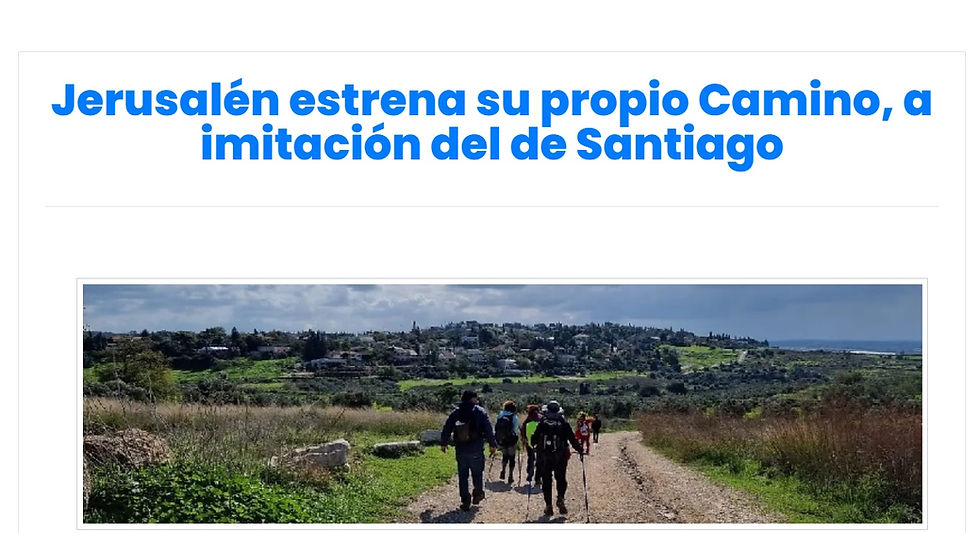
Eventually, they mapped out a 112-kilometer route to be completed over six days, from the port of Jaffa to Jerusalem. Their vision is to extend it in the future to around 450 kilometers, but for now they have focused on this initial section, which they have named “The Way of Silence.”
For the time being, the Camino to Jerusalem is not as developed as its counterpart in Santiago. It is not yet fully marked, so walking it requires a guide; only a few hundred pilgrims have completed it so far, and it remains relatively unknown. Still, it draws inspiration from the Spanish Camino: pilgrims carry a credential that is stamped at each stage; there is a modest network of places to stay—convents, monasteries, even schools and the journey offers a space for introspection and reflection. “It makes you a better person,” its founders say. “It is open to everyone Christians, Jews, Muslims, or those without religious affiliation. Our dream is that they walk together, speak, get to know one another, and learn to respect each other.” They add: “We truly believe that peace will come to Israel through this Way.”
The Camino to Jerusalem has a website in Spanish and English with all the information needed to undertake the journey.
Read More