
W2J News
7 באפר׳ 2026
The Pilgrimage Way to Jerusalem
Communities, Tolerance and Creation of a Multicultural Dialogue
From Us
Our journey began in July 2022 with a dream and a deep sense of purpose: to create a pilgrimage way to Jerusalem rooted in community and grounded in meaningful connections between cultures, religions, languages, and across time. For us, pilgrimage is a universal language one that transcends borders, faiths, and traditions.
Guided by the values of the Way, we believe it holds the power to inspire transformation both within ourselves and throughout the wider world.
We are guided by three core values that shape every step of this way: Humility, Simplicity, and Gratitude. These are not only ideals they are the foundation upon which the Way to Jerusalem is being built. We believe with all our hearts that a path grounded in such values can open hearts, deepen understanding, and nurture real change.
After much reflection, in September 2023 we founded The Way to Jerusalem Pilgrimage Association (NPO), choosing this framework to ensure that our vision and values remain at the center of all we do. For us, the Way to Jerusalem is a life’s work. We devote our time, energy, and spirit to developing and nurturing this initiative, and we are deeply moved to share it with you - step by step.
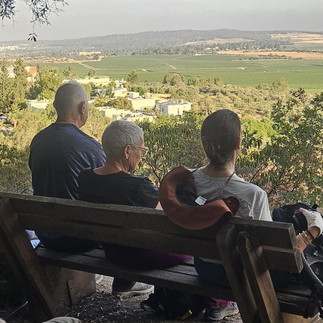
At times, we feel that in building the Way, we ourselves have become pilgrims. We encounter the landscape of the journey firsthand climbing demanding ascents, descending into quiet valleys, and sometimes standing at the summit as the wind brushes our faces and our hearts open wide.
We see the Way as both a platform and an invitation: to walk the earthly Jerusalem step by step, and in doing so, draw closer to the Jerusalem Above.
With deep friendship,
Yael & Golan
Who Are the Pioneer Groups?
The Way to Jerusalem is still in its first steps. A living path in motion, continually being shaped and gently sculpted by those who walk it. Every action taken now leaves a meaningful mark on its unfolding story.
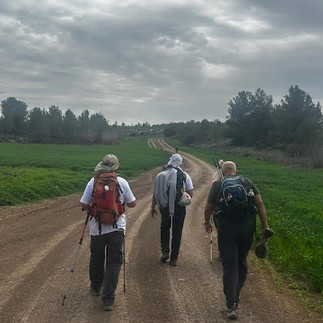
Pioneer Groups are far more than the first to walk the Way, they are the ones who give it breath, rhythm, and direction. For us, and for the Way itself, their presence shapes the culture, deepens the story, and leaves footprints that future pilgrims will follow.
Every ceremony, every encounter, every connection becomes a footprint in the emerging tradition of modern pilgrimage to Jerusalem. To be part of it is to shape the tradition itself.
About The Way of Silence
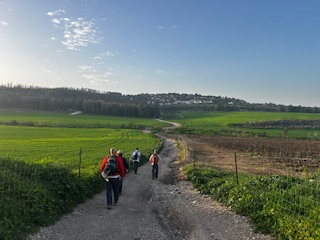
The Way of Silence begins at the ancient port of Jaffa and concludes at Jaffa Gate in Jerusalem’s Old City. Emerging from the vibrant urban landscape of a historic port, the path stretches across the coastal plain before ascending the three mountain ridges that embrace Jerusalem. Along its course, the Way crosses multiple historical layers, tracing routes shaped during the Biblical, Crusader, Ottoman, and Islamic periods, and continuing into our own modern era.
This path has served Jewish pilgrims since the time of the Second Temple (early first millennium), Christian pilgrims from the 4th century onward, and Muslim pilgrims from the end of the first millennium. Pilgrims traditionally arrived by sea through the port of Jaffa from the west, and by land across the coastal plain from the north
The earliest known route, supported by archaeological evidence, follows an ancient Roman road paved toward the end of the 1st century as part of an imperial network connecting the coastal plain to Jerusalem. From Jaffa, the road continued through Ramla and Lod, where it divided into two principal routes: the Beth Horon route and the Emmaus route. The Way of Silence retraces the path taken by pilgrims who journeyed from Jaffa to Jerusalem by way of Emmaus.
Who Is Your Hero?
We draw inspiration from historical pilgrims and the remarkable travel diaries they left behind living testimonies of faith, courage, and the human search for meaning. Without ever knowing it, they helped shape the spirit of the Way and gifted it a depth that continues to guide us today.
Egeria represents, the image of a strong, curious, and determined woman. One who followed an inner calling and crossed distances and boundaries with devotion. Felix Fabri embodies the profound longing to reach a sacred destination and the ability to see the journey itself as a space for reflection and transformation. Benjamin of Tudela reflects the spirit of discovery, the meeting of worlds, and the desire to encounter communities and cultures through the act of walking.
Alongside them, we are inspired by Ibn Battuta, one of history’s great Muslim travelers, whose vast journeys remind us that the path has always been a bridge between people, beliefs, and civilizations.
We would like to close with words that have long accompanied us.
A sentence we return to again and again, especially when we are asked why we chose to dedicate our lives to building the Way to Jerusalem. Within it lies a reminder of the strength found when faith is transformed into action, and of the deep joy that arises as a vision begins to take shape.
“It is no labor when one sees one’s longing fulfilled" (Egeria, pilgrim to Jerusalem, 4th century CE)
These figures invite us to remember that every pilgrimage is part of a larger human story and that those who walk the Way today are writing a new chapter in an ancient and ever unfolding tradition
Information about the 2026 pilgrimage journeys to Jerusalem, for those who feel called - Be a Pioneer in 2026






Read More